
Building a comprehensive cyber risk management plan involves identifying critical business assets and conducting thorough risk assessments to evaluate potential threats. Organizations must define their risk tolerance levels and implement tailored mitigation strategies to ensure security measures align with specific business objectives. This structured approach helps prioritize resources while maintaining a robust defense against evolving digital vulnerabilities.
Your organization has firewalls, antivirus software, and maybe even a dedicated IT team, yet a single phishing email or misconfigured cloud storage bucket could still bring operations to a halt, expose customer data, and trigger regulatory penalties. The gap between having security tools and having a coherent cyber risk management plan is exactly where most organizations are quietly vulnerable. A plan built on the right framework does not just protect your systems; it aligns security decisions with business priorities, helps leadership make informed trade-offs, and prepares your team to respond when something inevitably goes wrong. In this guide, you will learn how to build a cyber risk management plan from the ground up, covering asset identification, risk assessment, control implementation, and continuous monitoring across frameworks suited to your industry.
What Is a Cyber Risk Management Plan (and Why Most Organizations Get It Wrong)
A cyber risk management plan is not a policy document that lives in a shared drive. It is an operational framework that connects your organization's most critical business objectives to the cyber threats most capable of disrupting them. Where a cybersecurity policy describes rules and acceptable-use standards, a cyber risk management plan drives decisions: what to protect, in what priority order, with what resources, and what to do when something goes wrong.
Most organizations get this wrong in the same way. They treat compliance as the finish line. They complete a SOC 2 audit or satisfy a customer security questionnaire, then file the results and move on. Compliance is a snapshot; risk is continuous. A plan built around audit cycles rather than business continuity will fail the moment a threat emerges between reviews.
For organizations in San Jose and the broader Silicon Valley corridor, the stakes are higher than most. The regional concentration of intellectual property, cloud-dependent infrastructure, and deeply interconnected vendor ecosystems creates an above-average attack surface. Threat actors know this. Supply chain compromises and targeted IP theft are not hypothetical here; they are documented, recurring patterns.
A sound cyber risk management plan is a living document, reviewed and updated as the business evolves, not a one-time deliverable that signals due diligence.
Cyber Risk Management vs. Cybersecurity: Understanding the Difference
That distinction between cybersecurity and cyber risk management matters more than most articles let on, and conflating the two leads to real gaps in protection.
Cybersecurity is the collection of technical controls your organization deploys: firewalls, endpoint protection, multi-factor authentication, encryption. These are the mechanisms. Cyber risk management is the decision-making framework that determines which mechanisms you actually need, in what priority, and at what level of investment. One is execution; the other is strategy.
A practical analogy: cybersecurity is the lock on the door. Cyber risk management decides which doors need locks, how strong those locks should be, who holds the keys, and what your response is if a lock gets picked. Without the second discipline, organizations end up over-investing in controls that protect low-value assets while leaving critical systems exposed simply because no one asked the right questions.
A mature cyber risk management posture connects live threat intelligence to concrete business impact. That connection is what enables leadership to make defensible budget and resource decisions, rather than funding security based on vendor recommendations or last year's audit findings.
Step 1: Identify and Inventory Your Critical Assets
That decision-making framework only produces useful output if it is working from a complete and accurate picture of what the organization actually owns. Most are not starting from that position.
Asset identification means cataloging every resource your organization depends on, across three categories:
Data: Customer PII, financial records, proprietary source code, product roadmaps, contracts, and any other information that would cause measurable harm if exposed or lost.
Systems: ERP platforms, cloud environments, internal applications, operational technology, and the infrastructure connecting them.
Third-party dependencies: SaaS platforms, managed service providers, API integrations, and any vendor with access to your network or data.
For Bay Area organizations running hybrid workforces, that inventory must extend to remote endpoints: laptops, personal devices used for work, and home network connections that sit outside your direct control. A developer's compromised home machine is an access path into your environment just as surely as an unpatched server.
Shadow IT compounds this problem significantly in fast-growing organizations. Teams adopt cloud tools, file-sharing services, and collaboration platforms without IT visibility, creating undocumented dependencies that never appear in any formal asset register.
The operational principle here is straightforward: you cannot assess risk for assets you do not know you have. A thorough inventory is not a bureaucratic exercise; it is the foundation every subsequent step in your threat and vulnerability management services engagement builds on.
Step 2: Conduct a Cyber Risk Assessment

With your asset inventory in hand, the next step is systematic analysis: matching what you have against the threats and vulnerabilities most likely to affect it. This is the cyber risk assessment, and it is consistently the most-searched component of any cyber risk management plan, with queries like "cybersecurity risk assessment template" and "cyber risk management plan template" reflecting how many organizations know they need this but are uncertain where to begin.
A structured assessment works through three connected activities:
Threat identification: Cataloging the attack types relevant to your environment. For most organizations, that includes ransomware, phishing and business email compromise, insider threats, and supply chain attacks targeting your vendor or SaaS dependencies.
Vulnerability analysis: For each asset in your inventory, examining the specific weaknesses an adversary could exploit. A legacy system without active patching carries different exposure than a modern cloud application with enforced access controls.
Likelihood and impact estimation: Scoring each risk scenario based on how probable it is given your environment and what the business consequence would be if it materialized, whether that is operational downtime, regulatory exposure, or loss of customer trust.
A risk matrix plots these findings visually, mapping likelihood against impact to surface which scenarios demand immediate attention and which can be monitored over time. This prioritization is what separates a proactive posture from a reactive one. Small businesses in particular tend to skip formal assessments, which means their first real exposure to their actual risk profile comes during an incident rather than before it.
NIST CSF and ISO 27001 both provide structured methodologies that make this process more repeatable and defensible, without requiring organizations to build the approach from scratch. For organizations that need outside expertise, Vanguardia provides professional cyber risk assessment engagements designed to produce clear, prioritized findings that directly inform the next stages of your plan.
Step 3: Define Your Risk Tolerance and Treatment Strategy
A prioritized risk assessment tells you what you are facing. Risk tolerance defines what you are willing to live with. This distinction is where most cyber risk management plan guidance falls short, jumping directly from assessment findings to control selection without asking a more fundamental question: which risks does the organization actually need to eliminate, and which are acceptable to carry?
The four standard treatment options give leadership a structured way to answer that:
Accept: Acknowledge the risk and choose not to act, typically because the cost of mitigation exceeds the potential impact. Documented acceptance is not negligence; it is a deliberate, defensible decision.
Avoid: Eliminate the activity or asset that introduces the risk. If a legacy application creates unacceptable exposure, retiring it removes the exposure entirely.
Mitigate: Apply controls to reduce the likelihood or impact of the risk to a tolerable level. This is the most common treatment path.
Transfer: Shift financial exposure to a third party, most commonly through cyber insurance. Transfer does not eliminate the risk operationally; it limits the economic damage.
These decisions belong to leadership, not IT. A San Jose healthcare organization operating under HIPAA obligations has almost no latitude to accept risks involving protected health information. A local retail operation faces a different calculus entirely. Defining that risk appetite in writing also carries practical weight: several compliance frameworks explicitly require a documented tolerance threshold, and when an incident occurs, teams with pre-approved decision boundaries respond faster and with far less internal friction.
Step 4: Implement Security Controls Aligned to Your Top Risks

With risk tolerance defined in writing, control selection follows a clear logic: every control you implement should trace back to a specific threat scenario identified in your assessment, not to a generic security checklist or a vendor's product catalog.
Controls fall into three functional categories, each serving a different role in your risk reduction strategy:
Preventive: These reduce the likelihood a threat scenario materializes. MFA applied to your highest-privilege accounts, endpoint protection on remote worker devices, and network segmentation that limits lateral movement between your critical systems and less-sensitive environments all belong here. Note that the specific configuration matters; MFA on a low-risk internal wiki is not the same investment as MFA protecting your cloud infrastructure credentials.
Detective: These reduce the time between intrusion and discovery, which directly limits damage. Log monitoring, intrusion detection, and recurring vulnerability scanning give your team visibility into conditions that precede incidents, not just the incidents themselves.
Corrective: These determine how quickly you recover when something fails. Tested backups, disciplined patch management, and documented incident response procedures are the difference between a contained event and a prolonged outage.
For resource-constrained organizations, the sequencing question matters as much as the selection. Start with controls that address your highest-impact risk scenarios at the lowest operational cost. Hardening access controls on your most sensitive systems costs less than most detective tooling and closes more exposure per dollar than almost any alternative. The goal is not a perfect technical posture; it is measurable risk reduction relative to what your business cannot afford to lose.
Step 5: Build an Incident Response Plan Into Your Risk Framework

Controls reduce the likelihood and impact of incidents. They do not eliminate them. That is why incident response belongs inside your cyber risk management plan, not in a separate document that surfaces only after something breaks.
An integrated response plan covers five concrete elements:
Designated response roles: Someone must own each phase of a response. Who declares an incident? Who manages technical containment? Who communicates externally? Without named roles, these decisions get made under pressure by whoever happens to be available.
Communication chains: Internal escalation paths, external notifications to customers and vendors, and regulatory reporting obligations all need to be mapped in advance. California's CCPA imposes strict breach notification timelines, and failing to meet them creates legal exposure on top of the operational damage already in progress.
Containment procedures: Pre-approved steps to isolate affected systems without destroying forensic evidence. The order of operations matters; containment and preservation can conflict if the procedures are not thought through ahead of time.
Evidence preservation: Logs, system states, and access records that support both internal investigation and any regulatory or legal proceedings that follow.
Recovery steps: Sequenced restoration procedures tied to the business impact priorities you defined during your risk assessment.
For organizations without an internal IT team, the documentation layer is still achievable. Basic response procedures can be written, roles assigned to existing staff, and a managed security partner engaged to provide the detection and response capabilities that require dedicated tooling and expertise. The work with Vanguardia model exists precisely for this scenario, giving smaller organizations enterprise-grade response capacity without the overhead of building it internally.
Step 6: Monitor Continuously and Review Your Plan Regularly

An incident response plan that surfaces only during a crisis has the same structural problem as a cyber risk management plan that only gets reviewed at audit time: both assume the threat environment stands still while the organization moves forward. It does not.
Formal risk reviews should happen at minimum annually, but the calendar is not the only trigger. A significant IT infrastructure change, a new product launch that expands your attack surface, an acquisition that brings in unfamiliar systems and vendors, or a security incident all warrant an immediate reassessment. Any of these events can invalidate prior assumptions about likelihood, impact, or control effectiveness.
Continuous monitoring is where governance and technology intersect. The technical layer watches for anomalies. The governance layer translates those signals into leadership reporting and decision points. Key risk indicators (KRIs) are the metrics that make this practical: failed login attempt volume, unpatched systems count, and phishing simulation failure rates are all measurable conditions that shift before an incident materializes. When a KRI crosses a defined threshold, that is a prompt for review, not a post-incident autopsy.
A plan that is written and shelved does not stay neutral. As your environment changes and the plan does not, the gap between documented assumptions and operational reality grows. That gap is where adversaries operate.
Choosing the Right Cyber Risk Management Framework for Your Industry
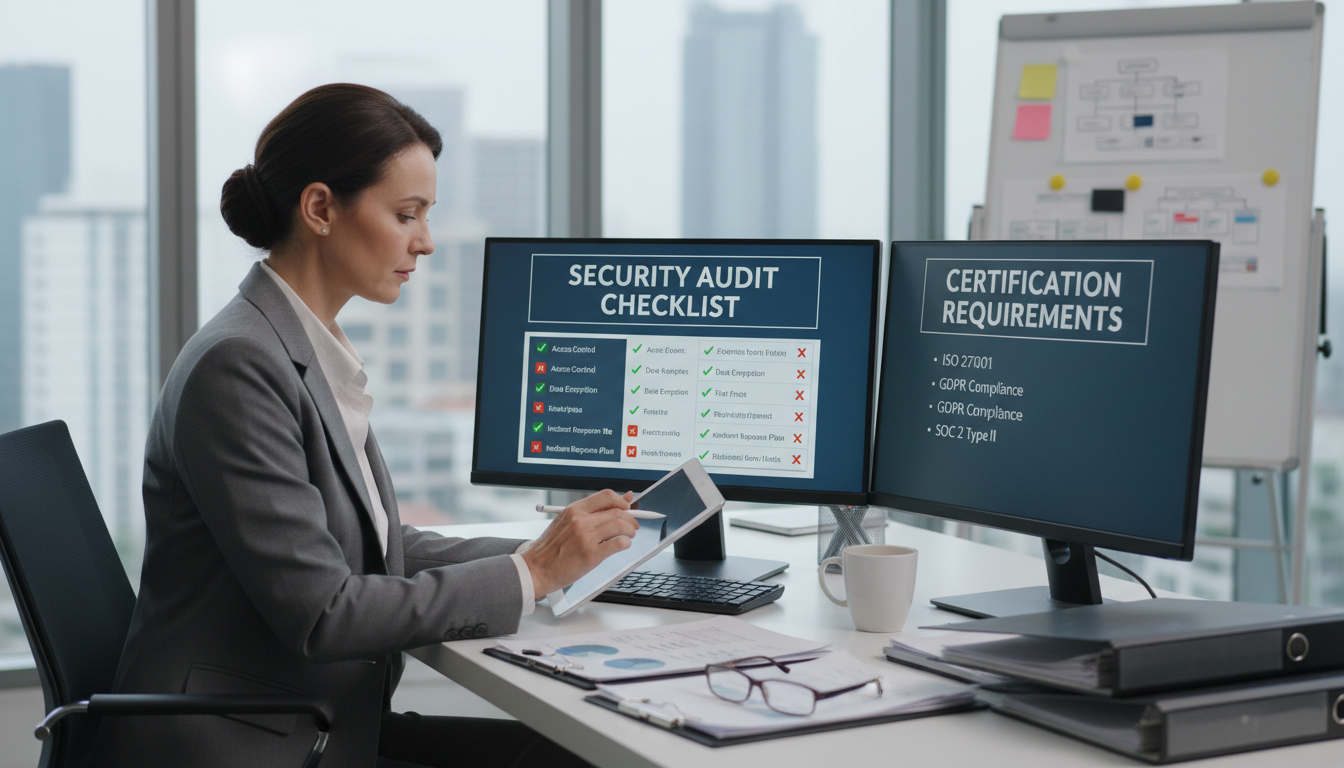
Selecting a framework to structure your cyber risk management plan is not about prestige or picking whatever a peer organization uses. It is about matching your compliance obligations, customer requirements, and current internal maturity to the framework that produces the most operational value with the least friction.
Three frameworks dominate most conversations:
NIST CSF: The National Institute of Standards and Technology Cybersecurity Framework is freely available, widely adopted across industries, and flexible enough to fit organizations at nearly any maturity level. It maps well to the identify, protect, detect, respond, and recover logic built into a sound cyber risk management plan.
ISO 27001: Internationally recognized and audit-ready, ISO 27001 is the right choice when enterprise customers or international contracts require a certified information security management system. The certification process carries real overhead; it is worth pursuing when customer requirements make it necessary.
CMMC: The Cybersecurity Maturity Model Certification is a requirement, not an option, for defense contractors handling controlled unclassified information. For veteran-owned businesses and government contractors in the Bay Area pursuing federal work, CMMC compliance is a prerequisite to bidding.
Vanguardia works with organizations across industries to evaluate these options against their specific environment and implement the framework that fits. If you are ready to move from planning to execution, work with Vanguardia to identify the right starting point.
Developing a comprehensive cyber risk management plan is the foundation of organizational resilience. By identifying vulnerabilities and establishing clear response protocols, you create a stronger defense against evolving threats. While these steps provide a solid starting point, maintaining a robust security posture can be a complex undertaking. If you want expert help in tailoring these strategies to your specific needs, feel free to explore our Services. We are here to help you navigate the landscape and ensure your digital assets remain protected.